Article No. 15
Life is a batch process. Adjust your schedule to it. - Read 29 Min.
6 By 6 Is the Fix. Yeah, It’s That Simple.
Top Sponsors of this Article
 Your Name - Your Organization Your Name - Your Organization Your Name - Your Organization Your Name - Your Organization
Table of Contents
The right daily eating cycle is the single most impactful thing you can do to avoid obesity and metabolic disease.
6by6 Is the Fix
6by6Living is the last course in the Nutrimatters curriculum. The details about how, what, and when to take action under 6by6Living are in the Nutrimatters 6by6Living Program section. Here, we'll pull all the other lessons together to summarize why there is a higher probability 6by6Living can help you avoid or reverse metabolic syndrome, obesity, and metabolic disease than other non-surgical or non-pharmaceutical programs.
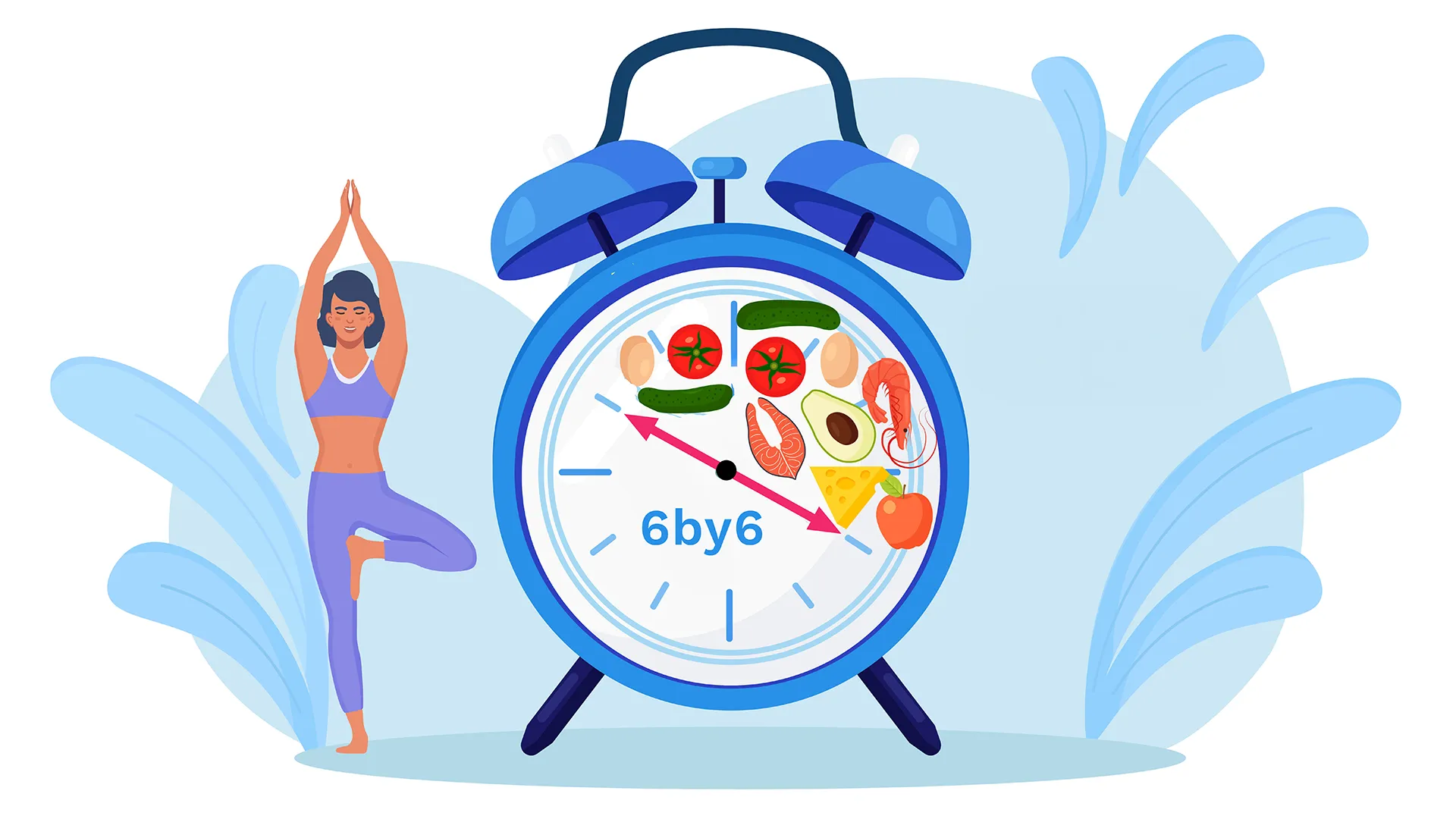
6by6Living gets its name based on doing all your eating in one continuous 6-hour period, and that period should not be within 6 hours of falling asleep. But there is much more to 6by6Living. The "when" to eat is emphasized because it is such a new understanding and so important, not because the other insights of 6by6Living are any less critical.
Another significant new Nutrimatters finding is demonstrated by the fact that 14 lessons preceded this one because you have to take a whole-system approach. If you have completed all prior Nutrimatters courses, that took a lot of motivation. That motivation likely comes from your disappointing results with just about every other Program focusing on weight loss and metabolic conditions.
But it was likely never about you. Whether a Hail Mary effort from the most obvious of charlatans or the best science of the most prestigious institution, they likely failed you because both, and everything in between, are typically based on a fundamental flaw in applying the scientific method.
Throughout history, humankind has innovated to bring astounding improvements to the human condition. Discussions of these improvements are often focused on things such as machines, technology, medicines, transportation, structures, and so on. However, one of the most impactful innovations was not a thing at all. It was a process known as the "scientific method."

Ironically, while the scientific method has led to the rapid advancement of science, there is a fundamental flaw in applying the scientific method that is a significant contributor to today's crisis of metabolic conditions.
Virtually all claims for a solution to the metabolic condition crisis start with some version of "based on science." Nutrition research and nutrition monetization feed off each other in a Faustian bargain. Contrary to popular belief, just because a sentence starts with "Studies show…" is not enough to buy a product, service, content, or belief system. And it is demonstrably obvious it's not enough to deliver success.
At Nutrimatters, we are guided by the work of Dr. Dennis Lendrem, who has dedicated his long career to improving the reliability of research and educating scientists about the pitfalls of bias, magical thinking, bad study design, confounders, cohort effects, starting with conclusions, and many other common practices that lessen the reliability of research studies. We also use studies, but we are very careful to vet each one and know that studies cannot stand alone, no matter how good. Studies must be used in the context of a solid theorem and model, be replicated and validated through experience and observation, and be devoid of conflicts of interest, career bias, and the influences of monetization.
We also use studies, but we are very careful to vet each one and know that studies cannot stand alone, no matter how good. Studies must be used in the context of a solid theorem and model, be replicated and validated through experience and observation, and be devoid of conflicts of interest, career bias, and the influences of monetization.
Far too often in nutrition, a significant result in one well-designed study, is extrapolated by commercial interest to a new monetization effort for a product, service, content, or belief system. This is simply not enough, especially in nutrition, which presents unique challenges to the scientific method. This unique challenge might be considered a flaw in the scientific method.
The Flaw That Gets Us All.
Here's a typical definition from OpenAI: "The scientific method is a systematic approach used by scientists to explore observations, test hypotheses, and generate knowledge about the natural world. It begins with an observation or the identification of a problem, followed by the formulation of a clear, testable question. From this, a hypothesis is developed, offering a potential explanation that can be tested.
"Experiments are then conducted to test the hypothesis, controlling variables to ensure reliable results. Data collected during experimentation is analyzed, often using statistical methods, to determine whether the hypothesis is supported or refuted. Based on the findings, conclusions are drawn, and if the hypothesis is supported, it may lead to further experimentation or contribute to broader scientific theories."
Note the part "controlling variables to ensure reliable results," which is fundamental to virtually every definition. The scientific method only works if the variables:
- Can be known and measured.
- Can be isolated and don't interact with each other.
- React predictably, i.e., don't significantly change behavior at unknown thresholds.
However, the scientific method breaks down when variables can't be known and measured, can't be isolated and interact with each other, change their behavior at unknown thresholds, or any one or combination of the three. Variables not meeting these expectations are typically why persistent problems, such as the metabolic condition crisis, are not solved. By the way, scientists can deal with variables with threshold effects but not with traditional designs.

As Dr. Lendrem points out, this expectation of variables manifests itself in what he calls the myth of the one factor-at-a-time (OFAT) approach to scientific experimentation. From the self-taught nutrition influencer who just lost 100 pounds to the well-known scientist steeped in gravitas who has identified a new peptide, belief in OFAT is fundamental to the validation of current failing mainstream nutrition doctrine.
OFAT is also known as a trial-and-error approach and what scientists call a heuristic approach. Regardless of name, they only work if variables meet the expectations of the scientific method, which we now know they don't for nutrition.
For example, notwithstanding some progress on the microbiome of the colon, virtually nothing is known about the thousands of species of the bioreactor's microbiome. Clearly, that variable is unknown, cannot currently be isolated and controlled, and interacts profoundly with other variables through the bioreactor ecosystem. And so it goes for the enteric nervous system, the bioreactor membranes, the biochemistry of digestion hormones, the role of the liver, and more, all interacting and influencing each other with many demonstrating significant threshold behavior.
It is now becoming clear that the human body relative to nutrition does not lend itself to the OFAT approach. Further, the vast majority of nutrition research does not meet the threshold for use as actionable knowledge due to a flaw in the scientific method.
OK, What Then?
Nutrition is not the only science struggling with this flaw in the scientific method. Physics, Astronomy, Astrophysics, to name a few, arguably have the same challenges. However, these sciences realized the weakness of OFAT far earlier and developed effective patches for the flaw, something not yet widely applied in nutrition.
These sciences use a whole-system modeling approach that allows scientists to simultaneously observe changes in all the variables. These sciences constantly face unknowable and uncontrollable variables and are constantly on watch for threshold shifts.
The whole-system modeling approach in these other sciences must be brought to nutrition. Failure to do so is why so many approaches in nutrition that attempt to control one variable at a time, such as diet, or exercise, or a particular digestive hormone, and so on, typically fail.

Yet, the commercial benefits of improving nutrition mainly accrue to those who offer a simple do this-one-thing solution. Stop eating meat, only eat meat, less fat, more fiber, more protein, no sugar, no alcohol, no dairy, plants only, and so on. These are typically based on OFAT research of variables that are broadly not fully understood in isolation and are all suspect due to the flaw in the scientific method.
Overcoming the weakness of OFAT and the flaw in the scientific method is why Nutrimatters uses a whole-system modeling approach and why there are 14 lessons ahead of this one. That's also why we don't call 6by6Living the 6by6Diet, because a diet is only part of the change required.
A lifestyle is a long-term whole-system change. We're not the first to advocate a whole-system lifestyle approach, but lacking a commercial incentive, we might be the first to say you must do it all and you must understand why.
Progress avoiding and reversing metabolic syndrome, obesity, and metabolic disease requires you to understand, build, and permanently maintain a whole-system model of your body's nutrition systems.
Building Your Model of You.
Building your own model of you begins with reviewing the essential elements of each of the 14 lessons and what they teach us about the requirements of the model. Like all good instruction sheets for model building, it's organized into steps.

Step 1 – Apply Course No. 1. If It's Only Temporary, Then It's Not a Cure, teaches the importance of consistency and long-term thinking. The recognition that fat cells can be filled/drained or created/destroyed is fundamental. The goal is to destroy fat cells permanently since temporarily draining fat cells provide little long-term health benefits. To permanently destroy fat cells, you must leverage the body's maxim, "Use it or lose it."
So if you want to lose it, don't use it. That means stop filling fat cells. How long without being filled before the body will remove fat cells? The current best thinking is 2 to 3 years from the last time you filled that particular fat cell. It's important to note, that's not 2 to 3 years from when you started the 6by6Living Program. It's from the last time you had a significant calorie surplus. That's right, overeating at that special event resets the clock. Ouch!
Small calorie deficits absolutely maintained over 2 to 3 years works. Large calorie deficits, but with occasional calorie surpluses, do not. The good news is that once the fat cells are destroyed, they don't get re-created as easily as re-filled. Therefore, eventually, you can return to those special events.
Step 2 – Apply Course No. 2. Counting Calories Adds Up to Failure, teaches the how and why counting calories rarely results in permanent weight loss, despite it being foundational to the vast majority of diet and weight-loss programs. Common sense dictates, and everyday observations show many people consume the same food as others, everything else being equal, like exercise, age, gender, etc., yet they gain weight when others don't. As Voltaire said, "Common sense is very uncommon." Despite this ubiquitous observation, the commercial weight-loss industry and much of medicine still believe in the calorie balance model.
While calorie surplus and calorie deficit have a role to play, there is a much better method for preventing overeating than counting calories. Let your body tell you when you've eaten just the right amount, you just have to learn how to listen. The body tells you when it has the right amount of food, but it does so 30 minutes after you've eaten. That means never eat until you are full at the table. If you do, you will always overeat. Learn to put a quantity of food on the table so that you feel full 30 minutes after you've finished eating. If you're still hungry, eat more. If you feel full before 30 minutes, eat less.
Step 3 – Apply Course No. 3. It's About Know Power, Not Willpower teaches that beyond a basic desire to avoid or reverse metabolic syndrome, obesity, and metabolic disease, willpower has little to do with success. It's easy to understand that so many disappointments trying current approaches has undermined your confidence. But it's not because of your willpower, it's because virtually everyone fails in a system biased toward failure.
However, when you learn that taking an advised action will yield a desired result, and then you take this action and get that result, it's not about willpower, it's about understanding and believing. It's about understanding through knowledge and believing through personal experience. For example, most people have learned and experienced that sleep is important, that caffeine disrupts sleep, and consuming caffeine before bed will disrupt sleep. So the vast majority of people can find the "willpower" to avoid caffeine before bed. That's all the willpower you need to avoid and reverse a metabolic condition once you learn and experience through 6by6Living.
Step 4 – Apply Course No. 4. You Can't Defeat Hunger, So Outsmart It teaches that a little short-term hunger is a great tool for regulating the timing and type of food that constitutes healthy eating. Make hunger your friend, not your enemy. Don't try to avoid all hunger by constantly eating or eating at the first hint of hunger. There are many hunger triggers, including boredom, social, and conditioned reflexes. Until you make your peace with hunger, avoid these triggers so you can focus on hunger generated by the need for nutrition.
Find something else to do when you're bored. Avoid social settings based on eating. Conditioned reflex eating is like scratching a skin itch. If you have a skin itch and constant scratching has started to damage the skin, you typically start to work to hold off on the scratching. It's the same with hunger. Hunger generated by the need for nutrition is pretty easy to spot if you're not constantly snacking.
If the hunger is stimulated by intense mental activity, wait 30 minutes before eating to see if the hunger will start to resolve because sugar is being transferred from the muscles. If the hunger occurs 3 to 4 hours after eating, it is likely due to the food bolus leaving the bioreactor. If it's 4 to 6 hours before bedtime or earlier, eat. If it's within 4 to 6 hours of bedtime, don't eat; the hunger will lessen, and you should sleep as soon as possible. Sleep is an effective mitigator of hunger.
Step 5 – Apply Course No. 5. Cellularly, You're Only Half Human teaches that for every human cell in the body, there is a non-human microbe cell, most of which play a critical role in human health and nutrition. Further, mounting evidence shows that these microbes either directly make or make the chemical building blocks for our critical biochemistry, including neurotransmitters that determine movement, rest and recovery, satisfaction, anxiety, and pleasure.
The FDA and factory food industry do little, if anything, to address the health and safety of these non-human microbes. This is where the argument begins to avoid all factory food with its preservatives designed to harm these microbes and the thickeners, emulsifiers, and additives that are likely to favor the unfavorable microbes.
Step 6 – Apply Course No. 6. Your Cells Don't Have a Mouth teaches that regardless of what you eat, cells can only use a relatively small number of nutrient molecules of amino acids, lipids, glucose, and vitamins and minerals. The primary purpose of the digestive system is to reduce all food to these nutrient molecules.
Most people get it right for amino acids, also known as protein, lipids, also known as fats, oils, and vitamins and minerals, but glucose, also known as sugar, is where most of the nutrition challenges arise. This lesson is where you start to learn about why understanding sugars are so important.
Step 7 – Apply Course No. 7. If It's Not Protein or Fat, It's Sugar teaches the key to avoiding or reversing a metabolic condition is realizing that if it's not protein, fats, oils, or minerals and vitamins, it's sugar as far as human cells are concerned. Sugar, carbohydrates, starches, and fiber are all reduced to a sugar called glucose. In other words, brownies and broccoli are the same on a cellular nutrition level. Therefore, despite many advantages, a high carbohydrate, plant-based, fiber-rich diet makes you even more susceptible to the challenges of too many of the wrong kinds of sugar.
The key to enjoying a carb-rich diet that includes some added sugar is understanding the how, what, and when of sugar. The how is mainly never drink added sugar in a liquid, and if you do, the what and when is simple sugars in the morning with food. So, a simple sugar like dextrose in your breakfast tea or coffee is the safest way to have added sugar in a liquid.
Further, eat most of your carbs early and increase your protein toward the end of the day. This is all designed to avoid exceeding the threshold that allows excess complex sugars to reach the liver through the hepatic portal in the bioreactor. Excess complex sugar in the liver leads to fatty liver disease, which leads to insulin resistance, which leads to metabolic syndrome, obesity, and metabolic disease.
Step 8 – Apply Course No. 8. You Breed What You Feed teaches that there is a complete ecosystem of microbes in your bioreactor. Like any ecosystem, there is a complex balance of species with essential interdependencies. Another standard characteristic of ecosystems is that favoring or disfavoring a particular species can disrupt the entire ecosystem and the life that depends on it.
All forms of life have a favorite food. There is mounting evidence that factory food is encouraging unfavorable microbes and discouraging favorable microbes resulting in bioreactor ecosystem disruptions. Thinking in terms of an ecosystem is also helpful in understanding that small changes can have catastrophic consequences that can take a long time to become apparent.
This is much like the landmark documentary the Silent Spring which raised awareness that the pesticide DDT was harming beneficial insects, in particular bees, which was threatening the pollination of many plant and tree species, and the life that depended on them. This is another data point for avoiding factory food.
Step 9 – Apply Course No. 9. Meet Your Essential Organ, the bioreactor teaches that there is so much more to your small intestine than transporting food through the digestive system allowing nutrients to seep into the bloodstream. The small intestine is an extraordinarily complex bioreactor that thrives on a relatively narrow range of conditions.
In fact, Nutrimatters believes a more accurate description of metabolic disease is bioreactor dysfunction and dysbiosis, otherwise known as damage to the small intestine and an unhealthy microbiome. This lesson emphasizes the benefits of eating 2 or 3 complete meals daily without snacking to create the optimal food bolus to support bioreactor functions.
Step 10 – Apply Course No. 10. When You Become the Infection teaches that it's not only about nutrition for energy. Avoiding and reversing bioreactor dysfunction and dysbiosis can have a significant impact on the body's immune system and cellular oxidative stress. Many of the symptoms of metabolic conditions, such as fatigue leading to becoming sedentary, brain fog, sore joints and muscles not related to exercise, and unusual hair and skin conditions, are the result of the infection-like symptoms of bioreactor dysfunction and dysbiosis.
By the time more medical symptoms of metabolic conditions like gaining weight and insulin resistance are medically recognized, the metabolic syndrome is typically well-developed. It will be significantly harder to halt or reverse. Don't ignore or accept these non-medical symptoms as normal or unavoidable.
Step 11 – Apply Course No. 11. Do You Know You Have a Second Brain teaches that there are more nerve cells in the digestive system than the brain with all the complex neuroprocessing except consciousness. One of the most important takeaways from this lesson is that the bioreactor needs the same 8 hours sleep as the brain.
While the brain can fall asleep quickly, the bioreactor has to finish processing any food in the bioreactor, which takes from 4 to 6 hours. Therefore, the bioreactor can't "fall asleep" until 4 to 6 hours after you put anything except water in your mouth. This is one of the critical understandings that drive the importance of when you eat.
Step 12 – Apply Course No. 12. It's About the Liver... Stupid! teaches that while the liver typically isn't considered part of the digestive system, it plays a central role in metabolic syndrome, obesity, and metabolic disease. Excess alcohol and sugar cause fatty liver disease, which causes insulin resistance which causes metabolic syndrome, obesity, and metabolic disease.
Excess alcohol is pretty straightforward; there is no amount of alcohol that doesn't contribute to fatty liver disease. But the effects are proportional. This means very little alcohol causes very little fatty liver disease. Also, there is very little difference as far as the liver is concerned between a glass of alcohol and a glass of sugar. So if a little added sugar is tolerable, current science suggests the same applies to alcohol. But having both a little added sugar and a little alcohol quickly gets problematic, such as a late meal heavy on carbs and alcohol.
Excess sugar is far more complicated because it's not the total sugar each day, it's how much sugar reaches the hepatic portal and gets to the liver. The same amount of sugar in a sports drink is far more likely to reach the hepatic portal than sugar bound up in vegetables in a food bolus.
Also, the extent of your bioreactor dysfunction and dysbiosis will have a significant impact on how much sugar reaches the hepatic portal. This is why metabolic conditions are so progressive, meaning as it gets worse, it gets even more worse at an accelerating rate. Current science indicates that in the average bioreactor and microbiome from a food bolus (not a liquid) can process 4 teaspoons of added complex sugar before it gets to the hepatic portal. This equates to about 1 to 2 ounces of alcohol in this context. Remember, this is either or, not both.
Step 13 – Apply Course No. 13. Eating Bad Food Impacts More Than Eating Good teaches that healthy food is rarely an effective antidote for toxic food. Healthy food can make the body more resistant to toxic food, but nothing helps more with toxins than avoidance. The primary reason offsetting toxic food, such as foods known to cause oxidative stress, with healthy anti-oxidant food, doesn't work well is the difficulty in getting the antidote to the toxin at the right place and time given the batch nature of food processing.
Also, it's not only about toxins and antidotes. It's also about some foods encouraging dysbiosis by encouraging unfavorable microbes that then compete better with favorable microbes. Don't fall into the trap of thinking you can eat factory food because you also ate some healthy non-factory food. Don't eat factory food.
Step 14 – Apply Course No. 14. When Is as Important as What You Eat teaches that in addition to giving the bioreactor and microbiome a rest, when you eat is important due to the circadian rhythm. Most people understand that the circadian rhythm refers to the body's daily cycle of hormone changes to support the awake sleep cycle. The body increases the concentration of hormones, such as melatonin as the sun sets to encourage sleep. It reduces melatonin and increases adrenalin as the sun rises to encourage being awake.
Fewer people are aware that something very similar happens with the hormones of digestion as part of the circadian rhythm. The hormone insulin turns food in the form of glucose during the daylight hours into energy and it turns glucose to fat during nighttime.
Therefore, you want to eat more of your daily allowance of sugar, starch, and fiber early in the day, not toward the end of the day. This will reduce insulin during the night which allows an increase in human growth hormone. Growth hormone uses protein for cellular growth and repair. This is the reason you want to increase your protein as you approach nighttime.
Let the Model Testing Begin.
The 14 lessons provide a broad understanding of how to build a whole-system model of your body's nutrition systems to optimally deal with the daily complex nutrition choices presented in the real world. Then, after you build a model, it is customary to start testing it. Use the 6by6Living Program as your model testing plan.
The first signs of change are in the lesser symptoms of metabolic conditions, such as fatigue leading to becoming sedentary, brain fog, sore joints and muscles not related to exercise, and unusual hair and skin conditions. Typically, after 6 weeks, many of these are noticeably improved, particularly with the skin and hair and fatigue.
Also, after 6 weeks, hunger begins to get more manageable, especially if you limit boredom and social eating. The brain fog lifts over the next few weeks, and the sore joints and muscles improve. If you're monitoring your bloodwork, you should see CRP, a measure of systemic inflammation, begin to improve.
If you deviate from the 6by6Living plan, the timeline resets. At first this is annoying, but soon it gives you the motivation to stick to the plan. You're likely to see a pound or two start coming off each month beginning in month three. That's not impressive compared with temporary weight loss programs, but you are less hungry and still eating well, and the weight loss will continue and really start to add up.
The best part is you'll understand why it is working and be able to personally experience the connection between action and result. If you can make 6 months of uninterrupted 6by6Living, you will likely never return to your old lifestyle. You will very likely reach the 2-to-3-year mark on 6by6Living and permanently avoid or reverse metabolic syndrome, obesity, and metabolic disease.
Actionable Knowledge
- 6by6Living gets its name based on doing all your eating in one continuous 6-hour period, and that period should not be within 6 hours of falling asleep. But there is much more to 6by6Living. The "when" to eat is emphasized because it is such a new understanding and so important, not because the other insights of 6by6Living are any less critical.
- Another significant new Nutrimatters finding is demonstrated by the fact that 14 lessons preceded this one because you have to take a whole-system approach. If you have completed all prior Nutrimatters courses, that took a lot of motivation. That motivation likely comes from your disappointing results with just about every other Program focusing on weight loss and metabolic conditions.
- But it was likely never about you. Whether a Hail Mary effort from the most obvious of charlatans or the best science of the most prestigious institution, they likely failed you because both, and everything in between, are typically based on a fundamental flaw in applying the scientific method.
- One-factor-at-a-time (OFAT) is also known as a trial-and-error approach and what scientists call a heuristic approach. Regardless of name, they only work if variables meet the expectations of the scientific method, which we now know they don't for nutrition. Progress avoiding and reversing metabolic syndrome, obesity, and metabolic disease requires you to understand, build, and permanently maintain a whole-system model of your body's nutrition systems. The 14 lessons help you build that model. 6by6Living is the plan to develop, test, and thrive using that model.
Article Top Sponsors

 Donate to Help Improve Articles
 Last Updated 07.16.26 08:46 AM ET